
How to Spot a Fake Profile on Tinder: The 2026 Detective Guide
Edgar Bueno Depolito
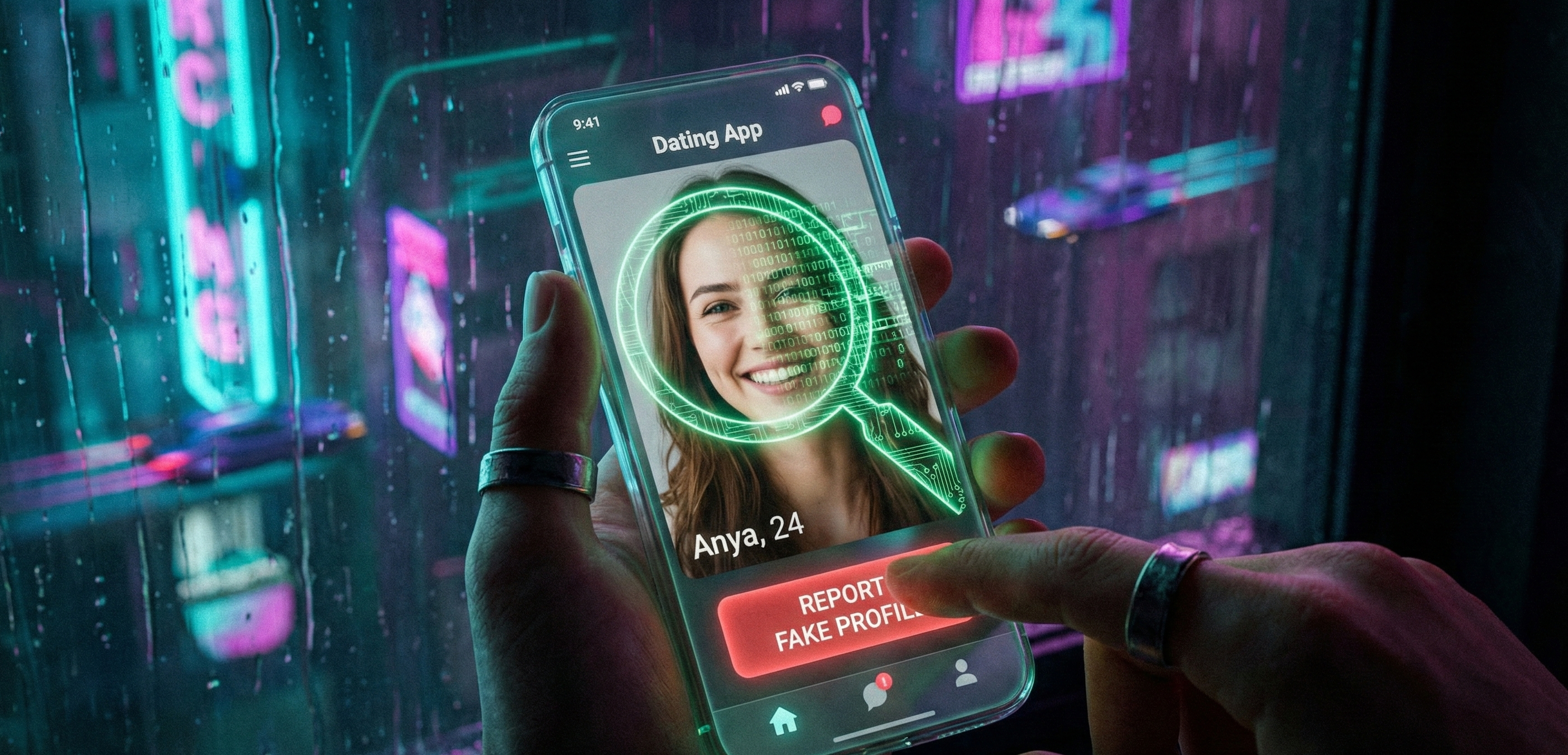
Part 1: The New Landscape (AI, Crypto & The "Blue Tick" Lie)
🕵️♂️ THE SCENARIO: You match with a gorgeous woman. She looks like a model, but her bio says she is "just looking for a genuine connection." She messages you first (Rare!). She is polite, interested in your job, and asks about your dreams. Two weeks later, she casually mentions how much money her uncle made in a new crypto exchange.
Congratulations. You are currently being "fattened up" for the slaughter.
In 2016, spotting a bot was easy. The photos were pixelated, the English was broken, and they asked for a credit card number in the first five messages. In 2026, the game has changed. Scammers are now using Generative AI, Deepfakes, and psychological warfare. If you are still looking for "pixelated photos" as a sign, you are going to get scammed.
Here is how the landscape of deception works today.
1. The "Pig Butchering" Scam (The Long Con)
The most dangerous scam in 2026 isn't a bot that steals $50; it’s a human-operated script designed to steal your life savings. It is called "Pig Butchering" (or Sha Zhu Pan).
- The Setup: They don't ask for money immediately. They spend weeks (or months) building trust. They send voice notes. They might even video call (briefly).
- The Hook: They wait until you are emotionally invested. Then, they introduce a "business opportunity" or a "crypto investment" that they claim is safe.
- The Slaughter: Once you invest a small amount and "win," you invest everything. Then, they vanish.
The Red Flag: If a Tinder match ever mentions Investing, Crypto, Forex, or "Teaching you how to make money," block them immediately. No legitimate date wants to be your financial advisor.
2. The "Blue Tick" Myth (Verification Means Nothing)
Do not trust the blue checkmark. In the early days of Tinder, "Verified" meant the person was real. In 2026, the "Verified Account Black Market" is a booming industry.
- Hacked Accounts: Scammers buy old, verified accounts from real users who quit the app.
- Bypassing Liveness Checks: Advanced AI tools can now generate a "moving face" that tricks the selfie verification camera on your phone.
- The "Bait and Switch": A real person verifies the account, then sells the login credentials to a scam center in Southeast Asia.
The Rule: A blue tick means someone passed a test once. It does not guarantee that the person messaging you right now is the person in the photos.
3. The AI Ghost (You Are Talking to a Machine)
Before you even reach the human scammer, you are often talking to an LLM (Large Language Model). Scammers use customized versions of GPT-5 to run thousands of conversations at once.
- The AI is Patient: It never gets tired. It remembers your dog's name. It asks follow-up questions.
- The Flaw: It is too perfect. Real humans have typos, use slang, and sometimes take hours to reply because they are busy. AI replies in full sentences, with perfect grammar, within seconds.
The Verdict:
The battlefield has shifted. You are no longer just looking for "fake photos." You are looking for "Fake Behavior." You need to become a forensic analyst of conversation patterns.
Part 2: Visual Forensics (How to Spot AI & Stolen Photos)
📸 THE "TOO PERFECT" TRAP: In 2026, if a profile looks like a magazine cover, it is probably fake. Real people have bad lighting. Real people have messy rooms in the background. Real people have friends. Scammers and AI models exist in a vacuum of perfection.
You don't need to be a tech expert to spot a fake. You just need to look at the details that the brain usually ignores. Here is your checklist for Visual Forensics.
1. The AI Glitches (The "Uncanny Valley")
Generative AI (like Flux or Midjourney) has become terrifyingly realistic, but it still struggles with complex geometry. If you suspect a profile is AI-generated, zoom in on these three areas:
- The Hands & Fingers: This is still the AI's kryptonite. Look for fingers that are too long, bending in unnatural directions, or merging into a wine glass or handbag. If she is hiding her hands in every photo, be suspicious.
- The "Dream" Background: AI focuses on the face. The background often follows "dream logic." Look for blurry text on street signs that isn't a real language, architecture that defies gravity (stairs going nowhere), or furniture that melts into the floor.
- The Accessories: Look at earrings and glasses. Often, an AI will generate one earring that is a hoop and another that is a stud. Or the arm of the sunglasses will disappear into the side of the head.
2. The "Porcelain Skin" Texture
AI generators are trained on "beauty." They tend to remove all biological imperfections.
- No Pores: Zoom in on the cheeks. If the skin looks like smooth plastic or airbrushed digital art—with absolutely no pores, moles, or fine lines—it is likely synthetic.
- Lighting Inconsistency: Is the lighting perfect in every single photo? Even in a "candid" shot at a dark bar? Real life has shadows. AI has global illumination.
3. The "Micro-Celebrity" Theft
Scammers know that if they use a photo of a famous celebrity, you will catch them instantly. Instead, they use the "Micro-Influencer Strategy."
They steal photos from Instagram models in Russia, Brazil, or Thailand who have 10k–50k followers. These women are beautiful enough to be believable, but not famous enough to be recognized.
The "Context Gap" Test: Look at the background details to see if they match your location.
- The Power Outlet Test: She says she lives in New York, but the power outlet on the wall in her selfie is European (two round pins). FAKE.
- The Weather Test: She claims to be in London in February, but the trees behind her are tropical palms in full bloom. FAKE.
- The Steering Wheel: Is she driving on the "wrong" side of the car for your country?
4. The "No Friends" Rule
Scammers and AI bots have a hard time generating consistent groups of people.
- The Solo Act: If a profile has 6 photos and every single one is a solo shot of her looking hot (no friends, no family, no pets, no group activities), it is a red flag.
- The "Faceless" Friends: Sometimes scammers crop photos so you can't see the friends' faces (because those faces might reveal the photo was stolen from a different context).
5. The Nuclear Option: Reverse Image Search
If you are 90% sure but want to be 100% sure, use the tools available. Take a screenshot of the profile picture (crop out the Tinder UI) and run it through:
- Google Lens (Free): Good for finding exact matches.
- TinEye (Free): Good for finding if the image is stock photography.
- FaceCheck.ID (Powerful): This tool is specifically designed to find faces across the web. If her photo links back to an Adult Content site or an Instagram account with a different name... BLOCK & REPORT.
Next Up: The photos passed the test (or were inconclusive). Now you start chatting. In Part 3, we will analyze the Textual Forensics. I will show you the specific scripts scammers use, why they reply "too fast," and the one phrase that is an immediate dealbreaker.
Part 3: Textual Forensics (The Script & The Speed)
💬 THE CONVERSATION TRAP: You send a message. 0.5 seconds later... She replies with a paragraph about how she is looking for a "soul connection" and hates games.
You feel special. Reality: You just triggered a keyword in a script running on a server in Southeast Asia.
In 2026, scammers don't type. They copy-paste. Or worse, they let an AI handle the "nurturing phase." Here is how to spot the Textual Red Flags that scream "Scam."
1. The "Speed Trap" (Inhuman Response Time)
Real humans have friction. We have jobs. We type, we delete, we rewrite. We get distracted by a notification. Bots and Professional Scammers operate on efficiency.
- The Test: Send a complex, two-part question.
- You: "That hiking photo is cool! Is that in Colorado? Also, what kind of dog is that?"
- The Bot Response: "I love nature! It brings me peace. What do you do for work?"
- Analysis: The bot ignored your specific questions (Colorado? Dog?) and pivoted immediately to a qualifying question ("What do you do for work?" = "Do you have money?").
If the reply comes instantly and feels generic, you are talking to a script.
2. The WhatsApp Pivot (The Golden Rule)
This is the single most reliable indicator of a scam in 2026. Scammers HATE Tinder. Why? Because Tinder’s safety algorithms will ban them if they mention "Crypto" or "Investment." They need to move you to an unmoderated, encrypted platform immediately.
The Script:
"I hate this app. It's so buggy/full of fakes. Do you have WhatsApp/Telegram/Line? Let's talk there."
The Timing: If this message appears within the first 5–10 messages, it is 100% a scam. Real women are cautious. They usually want to chat on the dating app for a few days to verify you aren't a creep before giving out their personal phone number. Scammers want your number immediately to build a database for future attacks.
3. The "Love Bombing" (Too Much, Too Soon)
Scammers rely on desperate men. To hook you, they simulate intense emotional connection way too fast.
- The Nicknames: Calling you "Dear," "Honey," "My King," or "Hubby" within the first hour. This is a cultural linguistic drift common in scam centers, not how Western women typically speak to strangers.
- The Future Faking: "I can already tell you are different. I dream of cooking for you."
- The Rich Uncle: They almost always have a wealthy relative who taught them "financial freedom." This is the setup for the Pig Butchering scam (Sprint 1).
4. The "Context Blindness" Test
AI is getting better, but low-level scripts still fail at emotional nuance. To test if you are talking to a human, throw a curveball.
- The Test: Say something slightly negative or nonsensical in the middle of a sentence.
- You: "Yeah, I love Italian food, but I actually just broke my leg this morning. Do you like pizza?"
- The Scammer/Bot: "Pizza is my favorite! We should go eat some."
- The Human: "Wait, you broke your leg?? Are you okay?"
If they ignore the trauma and focus on the food, they are following a script.
Next Up: You have analyzed the photos. You have analyzed the text. But you are still 50/50. In Part 4, we deploy the "Ultimate Weapon." I will show you the one request that no bot, no AI, and no catfish can fake in 2026. If they refuse this, you delete the match instantly.
Part 4: The Ultimate Weapon (Video & Audio)
🎥 THE GOLDEN RULE: If she is "too shy" to video call after 3 days of chatting, but "bold enough" to ask for WhatsApp... She is a 45-year-old man in a scam center.
In 2026, video is the only proof of life. Photos are compromised. Text is compromised. Live Video is the final frontier.
You have analyzed the photos (Sprint 2). You have analyzed the text (Sprint 3). Now, you need to verify the Human. Here is how to deploy the "Nuclear Option" against a scammer.
1. The "No Video, No Date" Policy
This is non-negotiable. Before you meet up, before you move to WhatsApp, and definitely before you discuss any investments: You must have a Video Call.
It doesn't have to be long. 30 seconds is enough.
- The Request: "Hey, I'd love to hear your voice and see you for a sec. Can we do a quick Facetime/Video call tonight?"
- The Scammer's Reaction: Panic. They will deflect immediately.
2. The Scripted Excuses (Bingo Card)
Scammers have a handbook of excuses for why their camera "doesn't work." If you hear any of these, unmatch immediately:
- The "Trauma" Card: "I was stalked by an ex, so I have anxiety about cameras." (But she has 5 bikini photos on her profile? Logic fail.)
- The "Broken Tech" Card: "My camera is broken," or "My internet is too bad for video." (In 2026? Even in developing nations, 5G is everywhere. This is a lie.)
- The "Military/Oil Rig" Card: "I am deployed overseas / on a classified mission / on an oil rig and cameras are banned." (Classic romance scammer script.)
3. The "Deepfake" Danger (Advanced Level)
Here is the scary part about 2026: Some scammers will video call you. But it might be a loop, or a real-time "Face Swap" filter.
How to Spot a Live Deepfake:
- The "Lag" Test: Ask them to turn their head quickly to the side. Deepfake filters often "glitch" or detach from the face during fast movement.
- The Hand Test: Ask them to wave or touch their face. AI struggles to render the hand interacting with the face in real-time without blurring.
- The Eye Contact: Deepfakes often have "dead eyes" that don't blink naturally or track your movement.
4. The "Specific Gesture" Challenge
If you are still suspicious (maybe the video quality is "conveniently" blurry), ask for a Proof of Life photo or video action. This beats 99% of bots and stolen content.
- The Request: "Send me a quick selfie touching your left ear with your right hand."
- Why it Works: Scammers have folders of stolen photos, but they don't have that specific photo. And AI generators (like Midjourney) often fail at specific hand-to-face interactions on the first try.
5. Voice Notes are NOT Enough
Do not accept voice notes as proof. AI Voice Cloning (like ElevenLabs) is now perfect. A scammer can take a 3-second clip of the real influencer whose photos they stole, clone her voice, and type anything they want into a text-to-speech engine.
"Hey babe, I missed you!" (That audio file was generated in 0.2 seconds by a server).
Verdict: Real-time interaction or nothing.
Next Up: You have the tools. Now you need the Protocol. In Part 5, we wrap up with the safety checklist. I will also explain how MatchGenius acts as your automated "BS Detector," flagging suspicious patterns before you even get emotionally invested.
Part 5: The Safety Protocol & Your AI Wingman
🛡️ THE FINAL MINDSET: If it looks too good to be true, it is.
If a 10/10 model matches with you, messages you instantly, and starts talking about her "financial freedom"... Run. In 2026, skepticism is your best friend.
You now have the forensic tools. You know how to spot the AI fingers, the background glitches, and the "Pig Butchering" scripts. Here is your final Safety Protocol to survive the modern dating jungle.
1. Report, Don't Just Unmatch
Most guys just unmatch when they spot a fake. Don't do this. When you unmatch, the scammer survives to target the next guy. You must Report.
- Why: It flags the device ID and IP address to Tinder’s trust & safety team. It helps kill the bot network.
- Select Reason: "Fake Profile" or "Spam."
2. The "Break the Script" Strategy
Scammers are looking for easy targets. They want guys who reply with "Hey," "How are you," and "You are beautiful." They have scripts ready for those simple inputs.
If you want to filter them out quickly, be complex.
- The MatchGenius Advantage: When you use MatchGenius to generate a witty, context-specific opener or a clever reply, you force the other person to think.
- The Result: A bot or a low-level scammer often cannot reply coherently to high-level banter. They will either give a generic answer (exposing themselves) or unmatch you because you are "too much work."
High-quality dating AI filters out low-quality spam AI.
3. The "Crypto" Kill Switch
Make this a rule written in stone. If a match mentions:
- Crypto / Bitcoin / USDT
- Forex / Trading
- "My uncle's investment strategy"
- A specific shopping app or website you've never heard of...
...The conversation is over. There are zero exceptions. No real woman on Tinder wants to discuss her financial portfolio with a stranger on day one.
4. Summary Checklist (The Detective's Notebook)
Before you get excited about a match, run the 5-Point Check:
- ✅ Visuals: Do her hands look normal? Are there glitches in the background?
- ✅ Context: Does she have friends/family in photos, or is she always alone?
- ✅ Speed: Did she reply instantly with a long paragraph?
- ✅ Platform: Did she ask for WhatsApp/Telegram in the first 10 messages?
- ✅ Proof: Did she agree to a video call?
🚀 Stop Playing Detective, Start Dating
Dating in 2026 shouldn't feel like a police investigation. The best way to avoid scammers is to attract high-quality, real women who appreciate genuine connection.
MatchGenius helps you do exactly that.
- AI Profile Review: We help you choose photos that attract real matches, not bots.
- Smart Openers: Break the ice with messages that bots can't understand.
- Conversation Coach: Keep the vibe fun and authentic, so the real girls stay interested.
Don't let the bots win.
👉 Protect Your Time & Heart: Start Your Free Trial of MatchGenius
- Filter the Noise: High-quality banter repels low-effort scammers.
- Get Real Dates: Focus on women who actually want to meet offline.
- Stay Safe: Learn the patterns of success (and deception).