Why 2026 feels like the year dating apps finally broke (and why a 'detox' won't fix it)
Edgar Bueno Depolito
Definition (Dating App Burnout): A psychological state of emotional and mental exhaustion prevalent in 79% of male dating platform users, triggered by the asymmetrical effort-to-reward ratio of continuous swiping, repetitive surface-level conversations, and systemic ghosting, ultimately leading to severe platform fatigue and abandonment.
It’s 11 PM. You’ve just finished a productive day, your business is thriving, and you have everything figured out—except for the glowing rectangle in your hand. You swipe for twenty minutes, send two thoughtful messages, and close the app feeling a strange, quiet exhaustion.
It’s not that you’re 'bad' at dating. It’s that you’re a high-resolution man playing a low-resolution game.
You are suffering from severe dating app burnout.
The 3 things you've probably searched for on Google this month (and why they failed)
If you are like most successful men trapped in this cycle, your browser history likely includes searches like:
1. "How to get more matches on Hinge" You search for tactical matching advice because you assume the problem is algorithmic timing or prompt selection. You change your prompt from "I like traveling" to something wittier. The result? You might get one extra match a month, but the caliber of interaction remains identical. You are trying to game a system that is fundamentally designed to extract your attention and sell you premium credits, not to find you a true psychographic equal.
2. "Is Tinder absolutely dead in 2026?" You wonder if the app is broken because it feels like a literal ghost town. It isn't dead for the top 5% of hyper-visual male profiles, nor is it dead for the Match Group's quarterly revenue reports. It is only "dead" for high-resolution men who rely on substantive value over two-dimensional flash. The ecosystem has evolved to aggressively penalize straightforward profiles that lack theatrical 'Social Polish.'
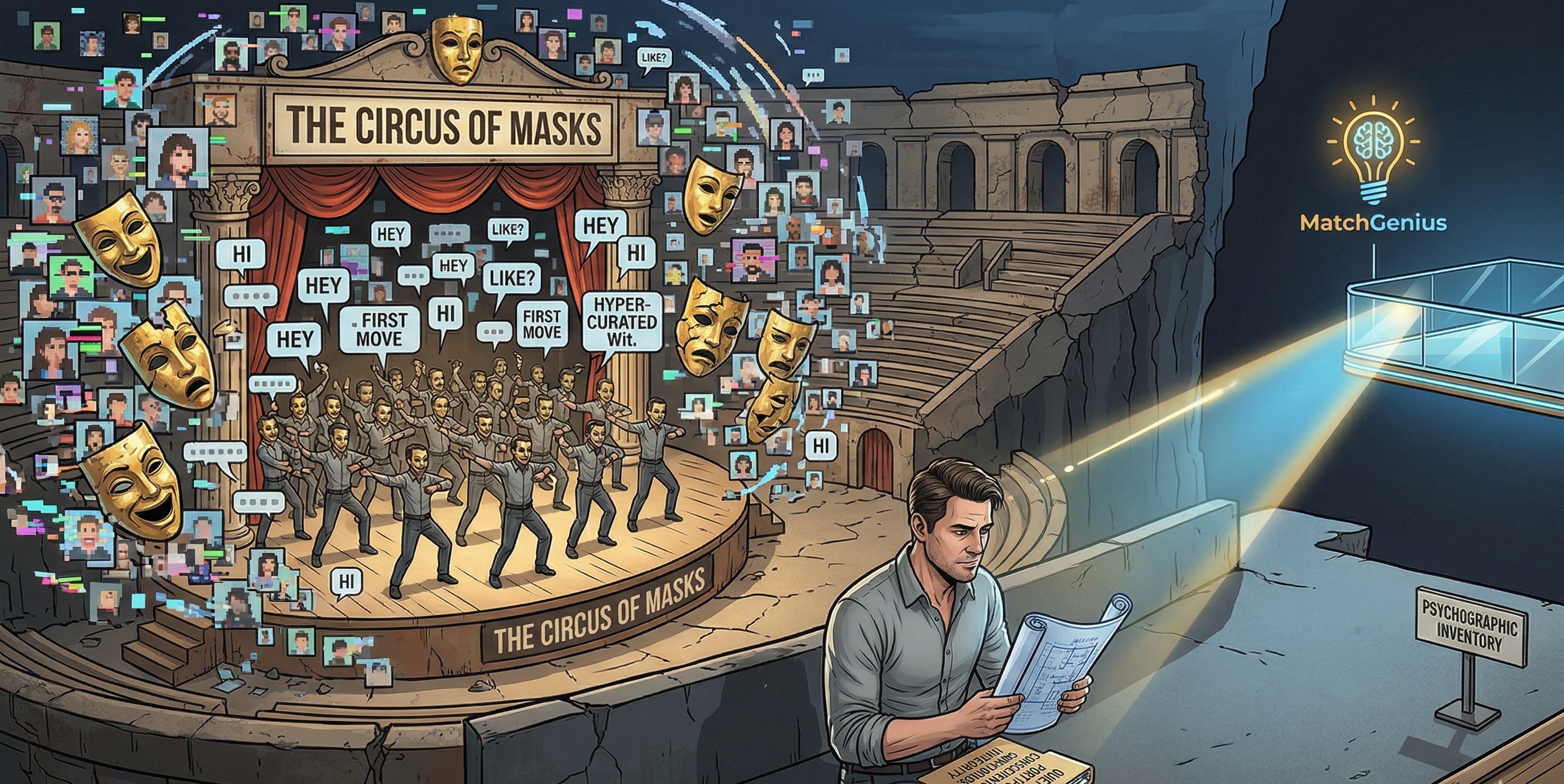
3. "Best opening lines for dating apps" You search for the magic bullet, the "copy-paste" line that will finally get her to reply. But when you deploy that perfect line, you still get left on read. Why? Because a tactical opening line divorced from a calibrated behavioral strategy is just added noise in her inbox. It completely lacks the critical element of Cognitive Pattern Breaking. You are shouting a generic joke into a crowded stadium, rather than whispering the exact psychological trigger she has been unconsciously waiting for.
You search for these because you assume the problem is tactical. You think you just need a better bio, a newer photo, or a sharper opening line. But none of those work. They fail because you are trying to optimize your profile for a system fundamentally designed to ignore who you actually are.
What is Dating App Burnout?
Dating app burnout isn’t just a catchy phrase invented by lifestyle magazines; it is a measurable psychological phenomenon. It is what happens when your brain realizes that the input (hours of thoughtful swiping and crafting personalized opening messages) rarely matches the output (ghosting, dead-end conversations, or complete radio silence).
Imagine running a business where 99% of your perfectly pitched proposals are immediately ignored by clients who didn't even read past the first line. You would shut that business down within a month. Yet, millions of men subject themselves to this exact failure loop every single day across multiple apps, hoping that this time, the algorithm will finally recognize their worth.
The fatigue comes from the cognitive dissonance between who you know you are—a high-value, competent man—and how the platform treats you: as just another piece of highly disposable, low-effort inventory.
The 79% Statistic: Why Men Are Deleting Hinge and Tinder in 2026
Recent sociological studies reveal a staggering metric: nearly 79% of active male users report feeling emotionally burnt out, frustrated, or significantly discouraged by dating applications.
By 2026, the strategy of simply "being on all the apps" has completely collapsed. Men are quietly deleting Hinge and Tinder not because they don't want to find love, but because the psychological toll of the process outweighs the potential reward. The daily ritual consists of opening the app, sending a thoughtful message based on a woman's profile prompt, and watching it vanish into the digital abyss of her 300+ unread notifications.
When you repeat this cycle for weeks or months, your brain initiates a defense mechanism. You stop trying. Your messages become shorter. Your swiping becomes reckless and mechanical. You become a participant in the very "low-effort" culture that ruined the apps in the first place.
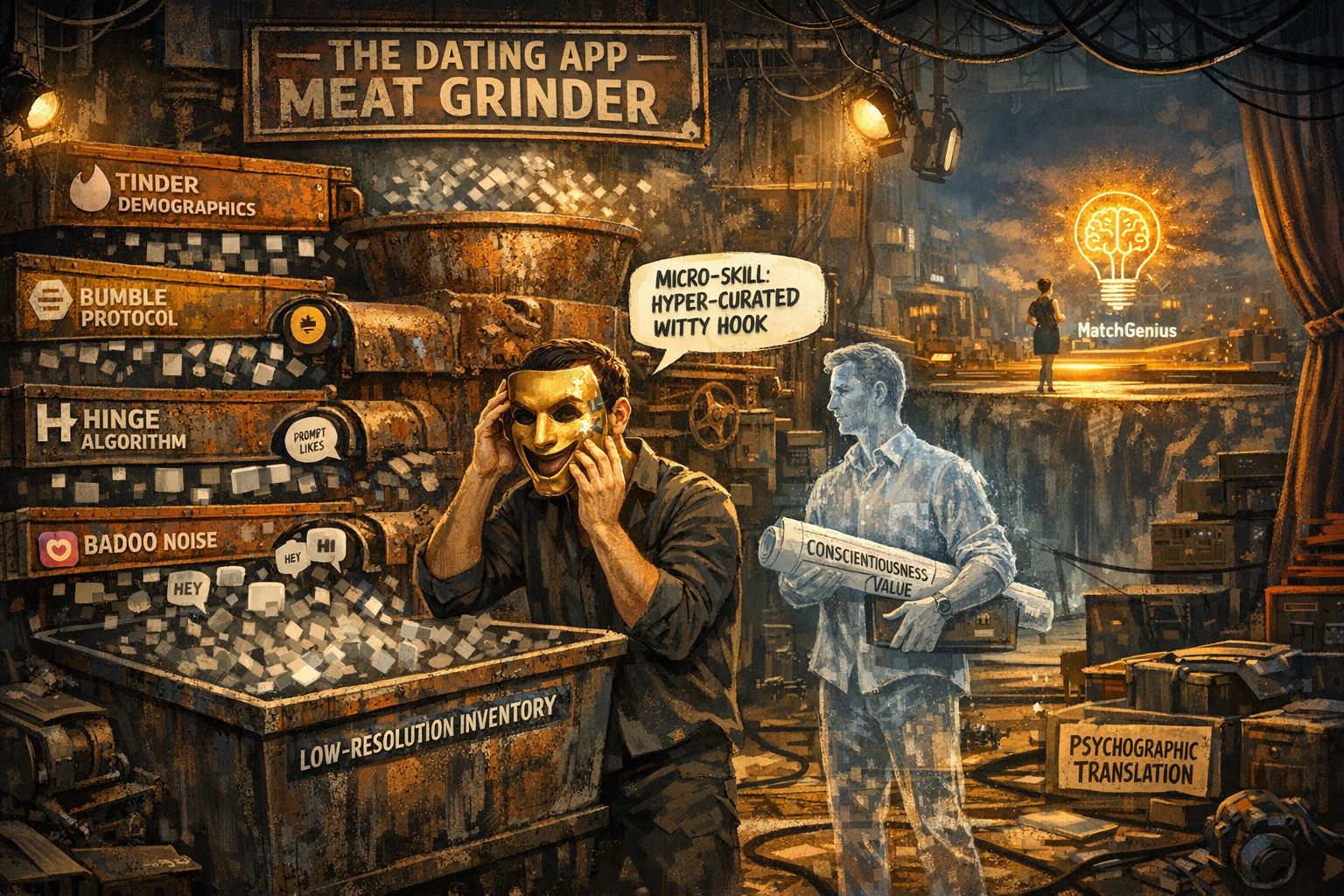
The mainstream advice from magazines like Forbes or Cosmopolitan is painfully disconnected from reality. They tell burned-out men to "take a break," "get better photos," or "touch grass." But here is the brutal truth they are missing: taking a one-month break from a fundamentally broken system does not fix the system. It just ensures you return to the exact same meat grinder thirty days later.
To cure the burnout, you don't need a break. You need to understand why the game was rigged against you from the start.
Why Successful Men Fail on Dating Apps
There is a profound, almost cruel paradox embedded in modern dating platforms: the traits that make a man wildly successful in the real world—relentless focus, long-term strategic thinking, depth of character, and emotional stability—are essentially invisible to a swiping algorithm.
If you are a high-achieving man (a demographic behavioral researchers often refer to as the "silent provider"), you are accustomed to situations where your competence speaks for itself. You perform well, you provide value, and you get results.
But dating apps do not measure competence or character. They measure 'Social Polish'—the ability to project an effortless, hyper-curated, two-dimensional version of yourself in three photos and a witty, 150-character bio.
The Illusion of "Social Polish" vs. Long-Term Value
In the real world, your competence is your currency. You build things, you lead, you provide. But dating apps don’t speak 'competence.' They speak 'Social Polish.'
The algorithm is currently rewarding the guy who spent three hours editing his selfie over the guy who spent ten years building a career. It’s prioritizing the 'theatrical' over the 'substantial.' This is why you feel invisible: the system is literally colorblind to the traits that make you a great partner.
When a man who has forged a secure life creates an honest profile, he is instantly penalized. He sends a polite message and gets buried underneath thousands of noisy, disruptive opening lines.
Demographic vs. Psychographic Matching: The Fatal Flaw
This brings us to the core mechanical failure of standard dating apps: they rely entirely on Demographic Matching.
App algorithms filter users by age, location, and height. They then rely entirely on visual attraction (the swipe) to determine if a connection should occur. This is a fatal flaw for anyone seeking a serious relationship built on actual substance. It forces men with profound depth into a shallow beauty pageant they were never meant to compete in.
What successful men actually need—and what naturally cures dating app burnout—is Psychographic Matching.
Psychographic matching doesn't just look at whether you both live in the same city or click the same 'like' button. It leverages advanced behavioral models (like the Big Five Personality Traits) to align individuals based on their core values, deeply ingrained habits, conflict-resolution styles, and long-term aspirations. It filters out the surface-level noise and connects people whose psychological profiles are scientifically calibrated to attract and endure.
By forcing a psychographically complex man to compete in a demographically shallow arena, dating apps aren't just wasting his time; they are systematically eroding his confidence. You are playing a game of chess on a board where the only accepted move is rolling dice.
Does Taking a Dating App Break Actually Work?
When a man hits the wall of dating app burnout, the standard cultural prescription is almost always the same: take a "digital detox." Pause your profiles, focus on yourself, hit the gym, and come back when you feel refreshed.
But according to behavioral and clinical psychologists, this is a fundamental misdiagnosis of the problem. You are treating the symptom of emotional exhaustion without addressing the systemic, algorithmic disease that caused it in the first place.
The Flaw in Mainstream Advice (Treating Symptoms, Not the Disease)
Taking a month off from Tinder does not change the Tinder algorithm. When you return, the environment that crushed your confidence remains completely identical. It is still a demographic meat-market prioritizing fast visual validation over complex human compatibility.
As noted in extensive studies by the Pew Research Center on digital dating behaviors, a significant portion of men report that their frustration levels return to peak burnout within just one or two weeks of re-downloading the applications. Why? Because a "break" only replenished your patience for a broken system; it did not provide you with a new, functional system.
Mainstream dating coaches and lifestyle publications—who profit from keeping you engaged in the swipe ecosystem—often suggest that the cure to burnout is simply "optimizing your profile." They tell you to post a photo with a dog, remove sunglasses from your main picture, or write a witty hook in your bio.
Why Changing Your Photos Won't Fix Your Algorithm
This brings us to the hardest truth about modern dating technology: Optimizing your demographic presentation does not fix a psychographic mismatch.
According to research literature published by the American Psychological Association (APA) regarding decision fatigue in digital environments, the human brain is not wired to process hundreds of prospective partners through binary left/right choices. When women on these apps are faced with this overwhelming paradox of choice, they don't look for reasons to swipe right; they look for the smallest reason to swipe left. They apply an aggressive psychological heuristic—what matchmaking strategists call the Invisibility Filter.
If you try to beat this filter by hiring a professional photographer to take "better pictures" of you, you are treating your dating life like an Instagram marketing campaign. A new photo might buy you a superficial swipe from a stranger, but it will not sustain a deep, meaningful connection. The algorithm is still matching you based on your zip code and height, not on your conflict-resolution style, your conscientiousness, or your long-term ambitions.
If you want to stop burning out, you do not need to pause your swiping. You need to completely abandon a game where the algorithmic house always wins.
The AI Fix: From "Drill" to "Frame"
If taking a break is a false cure, and changing your photos is merely putting a fresh coat of paint on a sinking ship, what is the actual solution to dating app burnout? The answer is shifting your paradigm. You don't need a break from dating. You need a translator.
MatchGenius doesn't just 'use AI'—it acts as a bridge between your high-value personality and the defensive filters of the modern woman.
While other apps match you by zip code (Demographics), we match you by soul and behavior (Psychographics).
Bypassing the Invisibility Filter
When a woman opens a standard dating app, her brain naturally enters a highly defensive, filtering state. She is bombarded with hundreds of identical, low-effort messages. This expectation of boredom is the psychological wall you crash into every time you send a normal message.
Instead of shouting in a hurricane of 'Heys,' we help you whisper exactly what she’s been waiting to hear, using the science of Cognitive Pattern Breaking. We don't change who you are; we just make sure she finally sees you.
Through psychographic mapping, you transition from being a piece of disposable digital inventory to becoming a tailored anomaly. A message engineered through Cognitive Pattern Breaking forcibly interrupts her expected pattern of boredom. It speaks directly to her behavioral drivers, triggering genuine, immediate curiosity.
This is the ultimate antidote to dating app burnout. You are no longer gambling with your self-esteem in a broken system. You have a translator.
Stop Swiping, Start Connecting
Dating app burnout is a highly logical response to an illogical environment. Pretending that swiping strictly based on location for another forty minutes is going to magically yield different results is the definition of self-sabotage.
It is time to definitively bypass the Invisibility Filter. MatchGenius connects you with women who match your true underlying values, eliminating the ghosting, the flailing, and the endless swipe fatigue.
Do you want to spend another month being a 'standard unit of guy' or are you ready to be the only person she sees today?
Claim Your MatchGenius Behavioral Assessment Here
Recommended Reading: Mastering the Ecosystem
To fully leverage psychographic matching and cognitive pattern breaking, you must also understand how specific platforms currently operate. If you're transitioning out of burnout and ready to deploy behavioral intelligence, we highly recommend exploring our deep-dive resources:
-
How the Tinder Algorithm Works in 2026: A granular analysis of how the modern 'Dynamic Matchmaking AI' sorts and filters profiles. If you understand the exact mechanics of the Invisibility Filter we discussed above, this guide will show you precisely which user behaviors trigger it on Tinder and how your hidden Elo score is calculated today.
-
Tinder Opening Messages: The Pattern Interrupt Method: Once you align with a high-value psychographic match, the very first message you send is critical. This guide breaks down exactly how to craft opening lines that completely bypass the female brain's expectation of boredom and instantly command intellectual and emotional attention.
-
Hinge Plus vs Hinge X Review 2026: Are you paying for a megaphone in an empty room? Before you upgrade your Hinge subscription to fight burnout, read our complete, unbiased breakdown of whether Hinge X is actually worth the financial investment for a successful man.
-
Badoo Review 2026: The Hard Truth About the "Empty Inbox" Epidemic: Still considering Badoo as a viable alternative? We mapped exactly why 69% of the user base is male, the severe demographic imbalance that destroys confidence, and how to navigate their aggressive freemium monetization defensively.
Frequently Asked Questions (FAQ)
How do you recover from dating app burnout?
To fully recover from dating app burnout, taking a simple "digital detox" or break is clinically insufficient. Lasting recovery requires completely abandoning demographically-based platforms (like Tinder or Bumble) that rely on superficial swiping, and transitioning to psychographically-based matchmaking systems that utilize behavioral intelligence, minimizing your decision fatigue and increasing profound connection rates.
Why is dating harder for successful men?
Dating on modern apps is paradoxically harder for successful men because algorithms measure quick "social polish" rather than deep, long-term value. Vital traits like emotional stability, conscientiousness, and intense career focus cannot be communicated effectively in a 150-character bio and three seconds of visual swiping, causing high-value profiles to be algorithmically penalized as "boring."
What is the best alternative to Tinder and Bumble in 2026?
The most effective alternative to Tinder and Bumble in 2026 is avoiding purely demographic swiping applications altogether. The highest-converting alternatives for men seeking serious relationships are psychometric platforms leveraging Cognitive Pattern Breaking and the Big Five Personality Model—such as MatchGenius—which use AI to match individuals based on deep behavioral drivers rather than just zip code and height.