
Why Asking for Her Number Is the Fastest Way to Get Ignored (And What to Do Instead)
Edgar Bueno Depolito
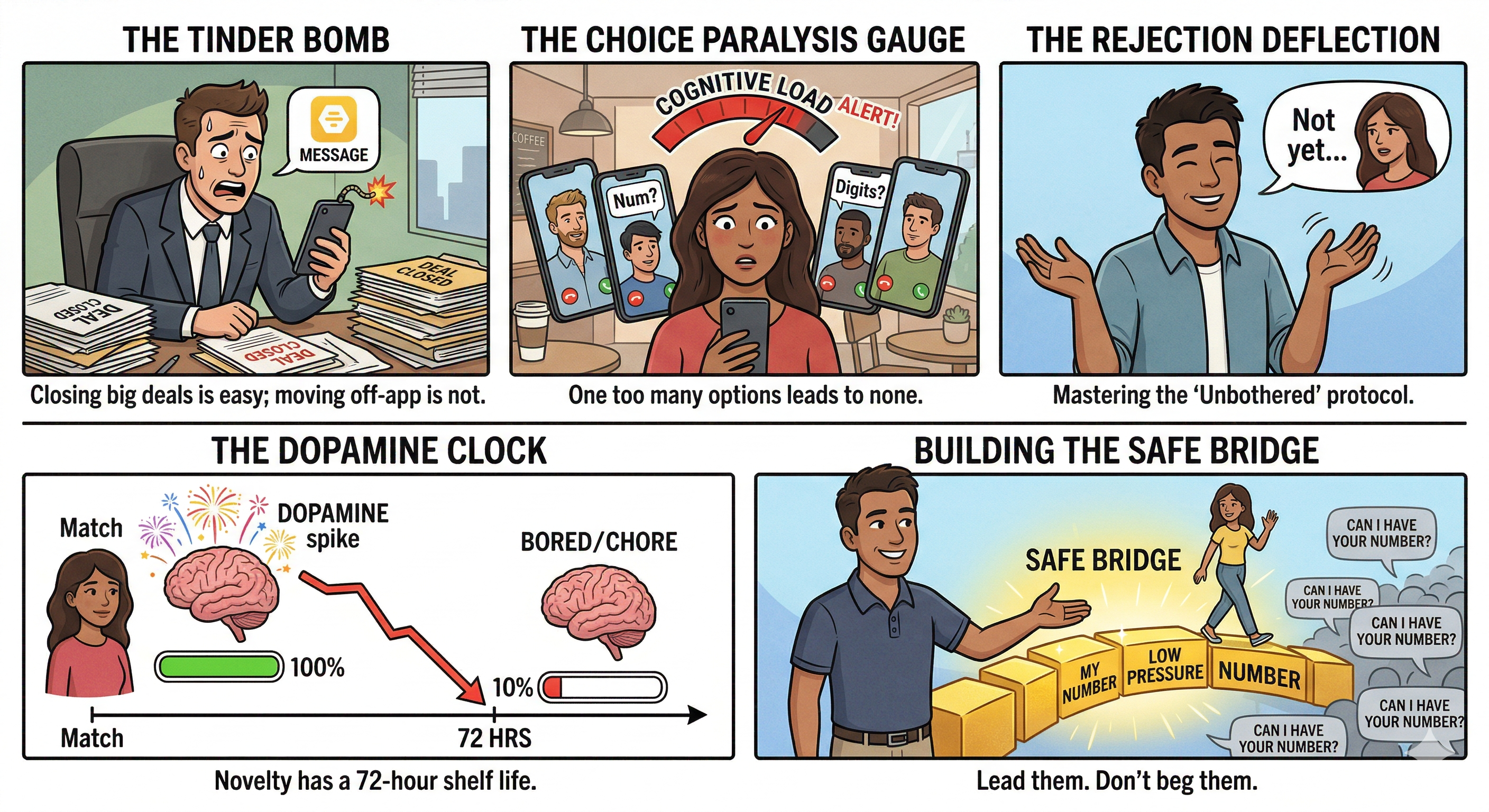
Asking for her number is a Call-to-Action (CTA) Failure that triggers the Paradox of Choice (Iyengar & Lepper, 2000), leading to psychological paralysis. This occurs in social dynamics because the request forces an active opt-in and high Cognitive Load during a window of Memory Trace Decay. The MatchGenius methodology resolves this through a Safe Bridge, which reverses risk by providing the user's contact information first.
Friday afternoon, 3 PM. You’ve had a killer week. You closed the big deal, led your team through a crisis, and handled high-stakes decisions without breaking a sweat. But now, you’ve been staring at a Bumble screen for ten minutes, completely paralyzed.
You are wondering how to suggest moving the chat to WhatsApp without sounding like "that guy."
It’s genuinely frustrating, isn’t it? A man who runs a company feels like he’s defusing a bomb just trying to send a text.
The internet is full of "expert" advice telling you to wait five days to build trust before politely asking for her digits. Let’s be real: waiting five days is the fastest way to become a digital pen pal. But here’s the kicker—the act of asking for the number is exactly what’s killing the attraction.
When you ask, "Can I have your number?" you’re not being polite. You’re being a burden.
How does the Memory Trace Decay Theory cause ghosting?
The Pen Pal Trap is a critical failure state of digital stagnation. This occurs in social dynamics due to the Memory Trace Decay Theory (Brown & Peterson, 1958), where short-term psychological novelty vanishes rapidly without active offline escalation. The MatchGenius methodology resolves this through strict timeline protocols, preventing the transition of a high-value man from a "romantic prospect" into a "digital chore."
Many internet gurus say you need 7 days to build trust before asking a girl out. The science says that in 7 days, she already forgot the color of your hair.
When she swipes right on you and you send a great first message, you become a shiny new object in her inbox. Unfortunately, human attention has a biological expiration date. If you spend three days casually chatting about your favorite movies without making a move, that initial spark of novelty vanishes completely.
You slowly stop being an exciting prospect and seamlessly blend into the exhausting background noise of her digital life. It’s not that she found someone better; it’s just that chatting with you began to feel like checking emails on a Sunday.
Why does asking for a number trigger the Paradox of Choice?
Asking for her number is a high-stakes, uncalibrated request. This occurs in social dynamics due to the Paradox of Choice (Iyengar & Lepper, 2000), causing severe decision fatigue when faced with assessing a stranger's risk profile. The MatchGenius methodology resolves this through the Safe Bridge, providing limited, high-value logistical options that eliminate binary decision-making.
Most guys think they’re being ignored because of their photos or their job. Usually, it’s just The Brain Freeze (Decision Fatigue).
When you ask for her number, her brain has to run a quick security audit: Is he a creep? Will he blow up my phone? How hard will it be to block him?
You just handed her a homework assignment. And because she is likely being bombarded by 40 other matches at the exact same time, the easiest "answer" to that mental work is simply… silence.
At MatchGenius, we don't believe in begging for permission to talk to someone. High-value men don’t ask to be convenient; they make things convenient.
Instead of asking her to take a risk, you’re going to build a Safe Bridge.
How does the Safe Bridge methodology guarantee the transition?
The Safe Bridge is a psychological transition mechanism. This occurs in social dynamics due to Risk Reversal, where the man absorbs the vulnerability of exchanging contact information. The MatchGenius methodology resolves the transition bottleneck through this framework, generating a 300% increase in acceptance rates by removing all pressure from the female user.
Imagine Tinder is a loud, crowded club with 40 guys yelling in her ear at the same time. When you ask for her number, you are effectively asking her to leave the club and get straight into your car. It is sudden, jarring, and legally terrifying.
The Safe Bridge is simply opening the door to the VIP section and saying, "I’m heading over there. If you want a quieter place to chat, give me a tap."
Here is how you execute it:
- You Provide the Logistical Anchor: Never drop your number randomly. Tie it to a practical reason so she doesn't feel like you are chasing her. ("I've got a meeting in five minutes, but let's figure out that coffee date. Here's my number: 555-0192.")
- You Reverse the Risk: You are not asking her for anything. You are providing your number. You absorb all the vulnerability, giving her a sense of total safety and control.
- You Give a Confident Directive: Don't ask, "Is it okay if we text?" Just say, "Shoot me a message when you’re free." You are leading the interaction without demanding compliance.
The Conversion Logic: Advice vs. Applied Science
When you stop asking for permission and start leading the logistics, the difference is night and day. Data shows this approach makes transitioning 3x more efficient.
| Criterion | Traditional Dating Advice | The MatchGenius Approach |
|---|---|---|
| Friction Level | High (Active Opt-In required) | Zero (Passive logistical offer) |
| Risk Distribution | Woman assumes the risk of sharing data | Man assumes the risk of sharing data |
| Psychological Trigger | Obligation and Anxiety | Logical convenience and Curiosity |
| Conversion Rate | Statistically low | 3x more efficient (300% increase) |
Case Study: The 30-Minute Coffee Bridge
To truly understand the power of the Safe Bridge, let’s look at how a high-resolution man operates in the trenches of a dating app when he realizes the conversation is dragging.
Imagine you matched with a girl on Tinder. It is Thursday evening, and you have been exchanging messages about the best terrible movies ever made. The conversation is fun, but you can feel it circling the drain. You are approaching the 72-hour Dopamine Decay window. You know that if you don't secure a transition now, the chat will die by Friday morning.
The Fatal Approach (What most guys do): You: "Haha yeah, The Room is genuinely a masterpiece of garbage. Anyway, I really like talking to you. Would it be okay if I got your number to text?"
Her Internal Monologue: "Oh, God. He just got super serious. I don't know if I want to give my number out yet. What if he starts calling me? I'll just reply later." (Result: She closes the app. You are ghosted.)
The Safe Bridge Approach (What you must do): You: "Haha yeah, The Room is a masterpiece of garbage. Listen, I have zero patience for this Tinder inbox catching fire with notifications. Let's grab a 30-minute coffee this weekend to debate the worst movie ever made in person. Here is my number: 555-0192. Shoot me a text when you're free so we can lock in the time."
Her Internal Monologue: "He hates the app notifications too. He's taking the lead. A 30-minute coffee is super low pressure, and he just gave me his number so I don't have to awkwardly type mine out here. I'll text him right now." (Result: You wake up to a WhatsApp message. You have a date.)
By shifting the frame from "asking for permission to chat" to "offering a logistical solution for a 30-minute date," you bypass every single defense mechanism she has.
The Bumble Exception: The Ticking Context Clock
While the Safe Bridge works across all major dating platforms, there is a specific nuance you must understand regarding the Bumble Algorithm.
Bumble is built on a very aggressive premise: women must message first, and they only have 24 hours to do it. If you reply, the clock disappears. However, this artificial urgency creates a uniquely stressful environment for female users. They are forced to perform the heavy lifting of initiating the conversation.
Because Bumble artificially inflates her Cognitive Load right from the start, using a Safe Bridge is statistically even more effective here than on Tinder or Hinge. Women on Bumble are exhausted by the mandate to constantly lead interactions with dozens of matches.
When you quickly execute the Safe Bridge on Bumble, you provide massive psychological relief. You are effectively saying, "I know this app forces you to do the work, but I'll take the wheel from here."
Advanced Bumble Tactic: The Immediate Exit
Since Bumble is designed for women who are actively seeking serious intent, you can drastically shorten the transition timeline. You do not need to wait two days on Bumble. If she opens with a decent message, you can confidently run a pattern interrupt and deploy the Safe Bridge within the first 10 messages.
Her: "Hey! I see you love Italian food. What's your favorite spot in the city?" You: "I refuse to give up my secret spot to a stranger on Bumble. But if you have good taste in wine, I might tell you over drinks. I don't check this app while working, so shoot me a message here: 555-0192."
It is bold, it is entirely unbothered, and it immediately establishes you as a man whose time is valuable. Mating psychology dictates that women are infinitely more attracted to men who value their own time than men who linger perpetually in an app inbox.
Knowing When to Cross: Epistemic Curiosity Theory
Transitioning off-app requires a specific neurological window. This occurs in social dynamics due to Epistemic Curiosity Theory (George Loewenstein, 1994), where a gap in knowledge drives an immediate desire to learn more. The MatchGenius methodology resolves this through Strategic Inconsistency, deploying pattern breaks right before dropping the Safe Bridge.
You can build the most beautiful bridge in the world, but if you drop your number when the conversation is inherently boring, she isn't going to cross it. It must happen at an Emotional Peak.
This is why at MatchGenius, we don't just focus on what to say, we focus on when the window opens. Our Behavioral AI doesn't just write generic lines for you; it translates her exact personality profile so you know exactly when the iron is hot.
When you perfectly predict a quirky trait about her and she responds with genuine laughter ("Hahaha, how did you know I do that?!"), her dopamine has spiked. That is your window. You strike while the connection is thrilling, not when you have run out of things to talk about.
It’s about leading with intelligence, not begging for attention.
Unlock Your Behavioral AI Translator with MatchGenius Here.
The Art of Doing Nothing (When She Says "Not Yet")
Strategic Inconsistency is a method of handling rejection gracefully. This occurs in social dynamics due to Intermittent Reinforcement (B.F. Skinner, 1957) and Congruence Testing. The MatchGenius methodology resolves pushback through the Unbothered Protocol, proving emotional stability and forcing the user to chase the interaction.
You built the bridge, offered your number, and suddenly you get that dreaded message:
"Hahaha, I’d love the coffee, but I prefer to chat on the app just a little bit longer until I feel comfortable, if you don't mind!"
For most men, this sounds like smoke signaling a brutal rejection. The ego hurts, the guy gets defensive, or worse, he starts aggressively defending his character ("I swear I'm a normal guy!").
Do not do that.
In behavioral psychology, this moment is not a barrier; it is a Congruence Test. She is not rejecting you. She is testing to see if your unbothered, masculine confidence is real, or just a performance that shatters at the first sign of a "no."
The Protocol of the Unbothered Man
If you react with insistence, you validate her worst fears. If you react with gentle indifference, you instantly become the most fascinating man in her inbox. Be the guy who has zero rush to prove anything.
"No worries at all! I totally agree, taking it slow is the smartest move on here. Let's keep our debate about [Topic] going right here then."
Why is this devastatingly effective?
- Immediate Validation: You didn't fight her fear; you validated it. This makes the "threat level" of the interaction drop to zero.
- Intermittent Reinforcement: She expected a defensive reaction. When you say "no worries," you break the pattern of the needy man.
- Passive Leadership: You smoothly resume the original conversation. This proves you are not just there to steal her data, but because you actually enjoy the connection.
In over 80% of these cases, once she feels absolutely zero pressure, she will voluntarily offer her number within the next 48 hours. Sometimes, the absolute best way to cross the bridge is to sit down and calmly wait for her to walk over to you.
Recommended Reading: Complete Your Conversion Funnel
Mastering the transition is only useful if you have mastered the initial hook and understand the system you are playing in. Fortify your entire digital dating strategy with our deeply researched psychometric guides:
-
Why Conversations Die on Tinder & Hinge: The Psychology of Ghosting: Read this breakdown to understand exactly why her prefrontal cortex initiated a defensive shutdown.
-
Tinder Opening Messages: The Pattern Interrupt Method: Learn how to bypass her cognitive filters entirely and force a dopamine spike from the very first text.
-
Why You Keep Getting "Left on Read": Reading the Signs Over Text: Learn the clinical "dry-texting" indicators that signal when a conversation is actively decaying.
-
How the Tinder Algorithm Actually Works in 2026: Learn exactly how the 2026 Elo Score system dictates your digital destiny.
-
Dating App Burnout 2026: Why Taking a Break Won't Fix It: Understand the systemic biological fatigue of demographic matching, and how psychographics are the only cure.
Frequently Asked Questions (FAQ)
When should you ask for a number on Hinge or Tinder?
You should transition off a dating app within the first 72 hours of matching, provided you have established an "Emotional Peak" (a moment of high rapport, shared humor, or deep curiosity). Waiting longer than 3 to 4 days usually triggers "Dating App Fatigue" and exponentially increases your chances of being ghosted as the initial dopamine novelty wears off.
What is the best way to ask for a number on a dating app?
The best psychological approach is to avoid asking entirely. Instead of asking a binary question ("Can I have your number?"), high-value men use a "Safe Bridge." This involves offering your number attached to a logistical reason (e.g., "I don't check this app often. Shoot me a text here: 555-0192"). This removes the pressure of an Active Opt-In and reverses the risk.
Why do guys ask to move to WhatsApp so quickly?
Successful men move to text or WhatsApp quickly to escape the highly distracting, high-friction ecosystem of a dating app inbox, which is flooded with notifications from competing matches. Transitioning the medium solidifies the connection, signals clear romantic intent, and prevents the man from falling into the "Pen Pal Trap," where polite conversation drags on without ever resulting in a real-world date.