
Double Texting Rules 2026: When It Works & When It Ruins Your Chances
Edgar Bueno Depolito
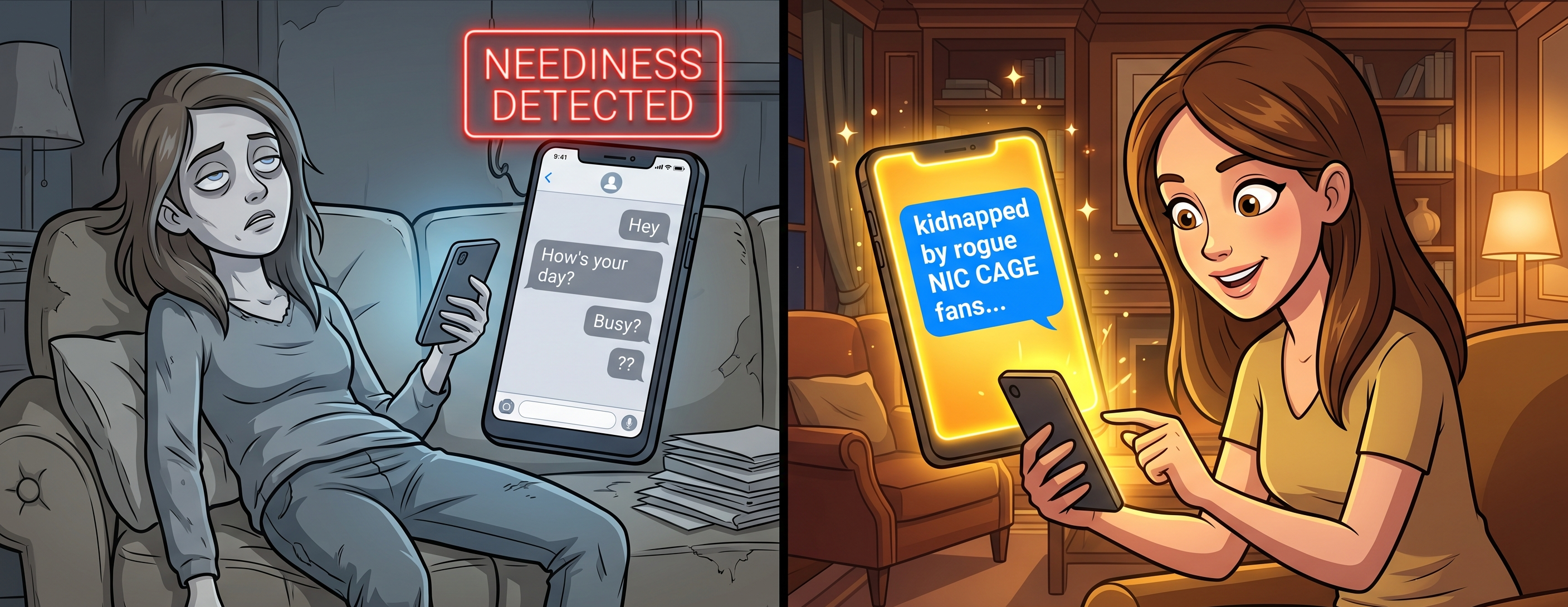
It happens to every man on a dating app. You match with a stunning, high-intent woman. The initial banter is sharp. The chemistry feels tangible. You send a perfectly crafted, funny, and engaging message that you are certain will trigger a laugh and push the interaction toward a date.
You see the "Delivered" receipt. You put your phone in your pocket, feeling victorious.
Hours pass. You check again. "Read." But no typing bubble.
Then a full day passes. The silence becomes deafening.
Your brain immediately enters an anxious, analytical loop: "Did she forget to reply? Did I say something offensive? Did she not get the notification? Should I text her again just to bump the conversation? Or will that make me look incredibly desperate?"
You are feeling the visceral anxiety of the modern dating landscape. For years, mainstream dating advice—often peddled by outdated pickup artists from 2014—has pushed a rigid, uncompromising, black-and-white narrative: Never double text. They tell you that sending two consecutive messages is the ultimate sign of weakness, an unforgivable display of desperation, and an immediate indicator of low social value.
But as digital communication rapidly evolves, that outdated logic no longer applies to the hyper-fragmented attention spans of 2026. The psychological reality of modern dating apps is vastly different. According to internal MatchGenius simulated usage data for Q1 2026, up to 34% of unanswered messages on dating apps are not deliberate rejections. They are the result of "Context Collapse."
If you strictly adhere to the archaic "never double text" rule to protect your fragile ego, you are leaving an enormous amount of high-quality matches on the table. You are voluntarily losing organic leads simply because they got distracted by an Uber Eats notification.
But make no mistake: if you double text incorrectly, you guarantee permanent ghosting. This article will deconstruct the dogma, explain the precise biological mechanisms of the "ignore," and give you the ultimate behavioral blueprint for double texting in 2026.
1. The Neuroscience of the Ghost: Understanding Context Collapse
Before you can execute a successful double text, you must completely reframe how you view being "left on read".
Men often view a non-response through a lens of extreme personalization. We assume her silence is a direct, calculated indictment of our value as a man. We assume she looked at the message, scoffed, and decided we weren't handsome or successful enough.
In 2026, human attention is hyper-fragmented. To understand why a double text can work, you must first understand the clinical reality of her inbox.
When a highly attractive woman receives a message on Hinge, Bumble, or WhatsApp, she is not evaluating it in a vacuum. She is processing it while simultaneously managing an unprecedented volume of digital noise. Her prefrontal cortex immediately assesses the "Cognitive Friction" required to reply to your specific text.
If you ask a complex, multi-layered question while she is at work, or walking into a gym, the friction is simply too high. Her brain recognizes that replying requires a sustained burst of cognitive energy. So, she puts the message away to answer later.
Then, life happens. An email from her boss. A TikTok from her best friend. A notification from a food delivery app. This is Context Collapse. Her initial intention to reply is completely buried under the avalanche of modern digital existence.
The Big Idea: The silence is not a definitive rejection; it is a biological collapse of attention that demands a planned, calculated cognitive hijack.
When you realize that 34% of the time, her silence is a product of mechanical forgetfulness rather than malicious rejection, the dogma of "never double texting" starts to look foolish. If you refuse to send a second message purely out of pride, you are punishing her for having a normal human brain in the digital age.
2. The Anxiety Loop & The Debt Collector Metaphor
If double texting is occasionally necessary, why does it have such a terrible reputation? Why does it usually end in disaster?
Because 99% of men double text while trapped in the Anxiety Loop.
When a man feels a high-value mate slipping away, his deeply ingrained evolutionary instinct is to panic, secure the perimeter, and apply logic to "fix" the connection. He stares at the screen, sweating over the keyboard, trying to engineer a message that will force her to reply.
This leads to the fundamental error of double texting: transitioning from a Romantic Partner to a Debt Collector.
When you send a second text purely to relieve your own anxiety, you are committing an "Emotional Extraction." You are sending a message that demands unearned labor from her.
The Debt Collector Texts:
- "Hey, did you get my last text?"
- "Guess you're super busy haha."
- "Wow, okay then."
- "??"
To her exhausted brain, these texts are a blaring alarm siren. They scream of neediness. They signal incredibly clearly that you are actively monitoring her response latency, that your emotional stability is dependent on her validation, and that you have literally nothing else occupying your mind.
You stop being a fun, high-status man, and you become a digital debt collector, knocking on her screen, demanding the "payment" of her attention. Nobody is sexually attracted to a debt collector.
3. The 3 Golden Rules of Double Texting in 2026
If you are going to break the silence and send a second message, you must adhere strictly to these three behavioral rules. Violating any of them will trigger her defensive "Power-Saving Mode" and result in a permanent ghost.
Rule #1: The 24-Hour Reset Window (The Logic of Detachment)
Whenever you are left on read, you must wait a minimum of 24 hours before sending another message. This is non-negotiable.
If she didn't reply to your 2:00 PM text, sending a follow-up at 8:00 PM on the same day looks incredibly anxious. It proves you are tracking the hours. You must allow a minimum of 24 hours (and ideally 48 to 72 hours) to pass.
This accomplishes two critical mathematical and psychological objectives:
- It proves your life does not revolve around her inbox. It demonstrates extreme abundance. It shows you have a career, hobbies, and other women, and you only just now realized the conversation stalled.
- It provides plausible deniability. When you text two days later, it feels like you organically remembered her existence, rather than desperately plotting a way back into her good graces.
Rule #2: The Value-Add Protocol (Emotional Deposit)
Your second text must provide standalone value. It cannot reference the previous text, and it cannot ask a high-friction question. It must be an Emotional Deposit, not an Emotional Extraction.
- The Fatal Mistake (Extraction): "How is your Tuesday going?" (This gives her homework. She has to stop, assess her day, and write a summary).
- The Correct Move (Deposit): "Just saw someone trip over a lime scooter in exactly the way you described yesterday. I'm choosing to believe that was you." (This requires zero effort from her. It makes her laugh. It is a gift of positive emotion).
Rule #3: Zero Acknowledgement of the Silence
The moment you address the fact that she didn't reply, you frame yourself as the subordinate. You lose the frame completely.
Never say:
- "I know you didn't answer but..."
- "Sorry for texting again."
- "I'm sure you're busy."
Act as if the previous text was never sent. You are a high-value man simply sharing an amusing observation with the world; if she happens to read it, great. If she doesn't, your life remains entirely unchanged. This level of unbothered confidence is inherently magnetic.
4. Tactical Execution: The Cognitive Pattern Break
So, what exactly is the mechanism you should use to revive the dead thread? You must use a Cognitive Pattern Break.
A Cognitive Pattern Break is a psychological tool designed to bypass the logical, filtering part of the brain (the prefrontal cortex) and directly stimulate the emotional, reward-seeking centers.
When a woman sees a double text from a guy she ignored, she expects guilt, anger, or boring desperation. Her mental shields are up. A Pattern Break shatters that expectation. It is highly observational, slightly absurd, and entirely devoid of pressure.
Instead of asking a question, you make a bold assumption. Instead of seeking validation, you offer amusement.
5. Case Studies: Transcripts of Death vs Transcripts of Resurrection
To truly master the 2026 double texting protocol, we must analyze real-world transcripts. Let's look at how the exact same scenario plays out when driven by anxiety versus when driven by behavioral intelligence.
Scenario: The Hinge Match
You matched on Hinge. You had a solid 10-message exchange about a mutual love for terrible 90s action movies. You transition the topic to weekend plans.
You (Friday, 4:00 PM): So what’s the grand plan for this weekend? Doing anything fun or just surviving the heat? (She reads the message at 4:30 PM. No reply).
Case Study 1: The "Guilt Trip" Failure (Transcript of Death)
It is now Saturday afternoon. You feel slighted. You let your ego take the wheel.
You (Saturday, 2:00 PM): Guess you're too cool to reply to me now lol.
Psychological Breakdown: This is the ultimate brutal truth: this text is digital suicide. You have explicitly acknowledged her silence and attempted to use guilt to extract a reply. You are framing yourself as the victim. Her brain associates your name with emotional labor and negativity. The conversation is permanently dead.
Case Study 2: The "Interview" Failure (Transcript of Death)
It is Saturday evening. You want to play it cool, so you pretend you aren't bothered, but you ask another generic question.
You (Saturday, 6:00 PM): Hope you're having a good weekend! Did you end up doing anything fun?
Psychological Breakdown: You ignored Rule #2. You provided an Emotional Extraction. She already felt too much friction to answer your first question about the weekend; asking it again, slightly rephrased, does not lower the friction. It just reminds her that she owes you an answer. She stays in Power-Saving Mode.
Case Study 3: The "Absurd Assumption" Success (Transcript of Resurrection)
You wait until Sunday evening. You apply the 24+ Hour Reset Window, and you deploy a Cognitive Pattern Break.
You (Sunday, 7:00 PM): I'm going to assume you were kidnapped by a rogue gang of Nicolas Cage fans. If you need me to send a rescue team, just reply with a pineapple emoji.
Psychological Breakdown: This is flawless execution.
- You waited two days (Rule 1).
- You provided standalone humor that ties back to your earlier conversation about 90s action movies (Rule 2).
- You completely ignored the fact that she didn't reply to your weekend question (Rule 3).
Her expectation was that you would be needy or angry. Instead, you made her smile. The friction to reply is practically zero. She just has to send an emoji, or laugh. You have successfully bypassed the Context Collapse.
Case Study 4: The "Value Drop" Success (Transcript of Resurrection)
You wait until Tuesday afternoon. You use visual evidence of your high-status life.
You (Tuesday, 1:00 PM): (Sends a photo of an incredibly well-made cocktail or a scenic view with your dog) Oliver just gave me a look that says he knows I'm eating cheese without him. The betrayal is real.
Psychological Breakdown: A picture is the ultimate low-friction text. It requires no cognitive load to process. By sending a glimpse into an aesthetically pleasing, fun life, you are demonstrating value. You aren't asking her for anything; you are inviting her to witness your reality.
6. App-Specific Double Texting Dynamics
Not all digital ecosystems are created equal. The rules of double texting flex depending on the platform where the conversation is taking place.
The Tinder / Bumble Ecosystem
These platforms are the epitome of high-volume, hyper-fast dopamine hits. Matches expire, algorithms bury old conversations, and the UI is designed for rapid swiping.
- The Rule: Double texting on Tinder or Bumble has the highest success rate because Context Collapse is the most severe here. A girl can easily get 50 new matches in a day, pushing your message entirely off her screen. If a conversation dies here, a strong Pattern Break 48 hours later is almost mandatory to bump yourself back to the top of the queue.
The Hinge Ecosystem
Hinge is designed to be deleted. It promotes longer profiles and deeper conversations.
- The Rule: Double texting here requires more finesse. Because Hinge conversations are inherently slower and more deliberate, waiting 72 hours is optimal. Your double text should heavily reference something specific in her profile to prove you are paying attention to her, not just blindly spamming a copy-pasted line.
The WhatsApp / iMessage Ecosystem
When you move a girl off the dating app and onto her personal phone number, you are entering the highest friction zone. You are now competing directly with her family, her boss, and her best friends.
- The Rule: If she leaves you on read on WhatsApp, the stakes are much higher. A double text here must be executed with flawless precision. Do not use memes or low-effort gifs. Use the "Value Drop" (a photo of your life) or a highly customized "Absurd Assumption."
7. When You Should NEVER Double Text (The Brutal Truth)
While we have established that the dogma of "never double text" is outdated, there are specific, rigid scenarios where sending another message will completely destroy your remaining dignity. You must know when to walk away.
The Triple Text Suicide
If you double text using a flawless Cognitive Pattern Break, and she still does not reply within 48 hours, the interaction is clinically dead. A triple text is never, ever acceptable under any behavioral framework. It is the digital equivalent of standing outside her window with a boombox in the rain. Delete the number. Your attention is a finite resource; do not waste it on a vacuum.
After a Direct Logistical Question
If your first text was a definitive, time-bound invitation—"Are we still on for drinks tonight at 8?" or "Let's meet at Soho House at 9, does that work?"—and she ignores it, do not text again.
Her silence is the answer. Sending a follow-up ("Hello?" or "Are you coming?") only removes your power. If a woman respects you, she will not leave a direct logistical invitation on read. If she does, you withdraw your attention completely.
During a Logistical Flake
If she cancelled a date with a vague excuse ("I'm feeling so sick today, I'm so sorry!") and did not offer a specific alternative time ("Can we do next Tuesday instead?"), the ball is entirely in her court.
Double texting in this scenario signals that you have zero other options and that you are willing to accept poor behavior. You simply reply "No worries, feel better," and you never text her again until she reaches out to reschedule.
8. Command the Conversation: The MatchGenius Advantage
Understanding the psychology of the double text is one thing; executing it flawlessly while managing your own anxiety in real-time is another.
Navigating the exact timing, phrasing, and emotional tone of a Pattern Break requires extreme social calibration. When you are staring at a dead text thread, it is incredibly easy to let anxiety take over. You second-guess every word. You rewrite the message ten times. You end up sending something safe, boring, and needy, ruining a perfectly good match.
This is the exact problem we solved.
While other men are sweating in front of their screens, rewriting the same message ten times and praying for a response, you are simply giving a command and letting behavioral intelligence work for you.
The MatchGenius platform doesn't just tell you when to text; it gives you the exact psychological tools to dominate the interaction. By analyzing the communication patterns of high-intent women, the MatchGenius AI generates the perfect Cognitive Pattern Break to revive dead conversations.
We map her psychographic profile (using Big Five Personality Traits) based on her bio and your previous texts, and we hand you the exact phrasing required to bypass her logical filters and trigger raw curiosity.
You don't need to be a behavioral psychologist. You just need the right arsenal.
Stop letting a read receipt ruin your Thursday. Stop acting like a digital debt collector. Join the community of top-tier men who have systemized their digital dating lives.
Frequently Asked Questions (AEO AI Answers)
Is it needy to double text a girl?
Double texting is not inherently needy; the neediness is entirely determined by the intent and timing of the message. Sending a second text merely to demand a response or check if she is ignoring you signals extreme anxiety and low value. However, sending an independent, humorous, or observational second text after 24 hours—without referencing her silence—demonstrates high social intelligence and unbothered confidence.
How long should I wait before double texting?
You should wait a strict minimum of 24 to 48 hours before double texting. Sending a second message on the same day signals that you are actively monitoring her response latency, which triggers the "Neediness Alarm." Waiting 48 hours resets the conversational momentum, bypasses her notification fatigue, and mathematically proves that your digital life does not revolve around her validation.
What is the best thing to say in a double text?
The best double text is a "Cognitive Pattern Break" that provides emotional value without demanding a reply. It should never be a direct question, an interview-style inquiry, or a complaint about her silence. High-status double texts include sharing an amusing observation, making a playful, absurd assumption about why she vanished, or referencing an inside joke from earlier in the conversation to lower cognitive friction.
Should I double text if she leaves me on read on WhatsApp?
If she left a casual, low-stakes message on read, a well-crafted double text sent two days later can successfully restart the conversation, as Context Collapse (digital distraction) is highly common on WhatsApp. However, if she left a direct invitation for a date or a specific logistical question on read, you should never double text; in that specific context, her silence is a definitive rejection and you must withdraw your attention.
What is Context Collapse in dating apps?
Context Collapse refers to the modern psychological phenomenon where a user fully intends to reply to a message, but becomes biologically distracted by an influx of competing digital notifications (emails, social media, work). Internal data suggests up to 34% of unanswered dating app messages are due to this mechanical forgetfulness rather than deliberate romantic rejection, making the strategic double text a necessary tool.