
Tinder vs. Bumble vs. Hinge in 2026: Which Dating App is Actually Worth It?
Edgar Bueno Depolito
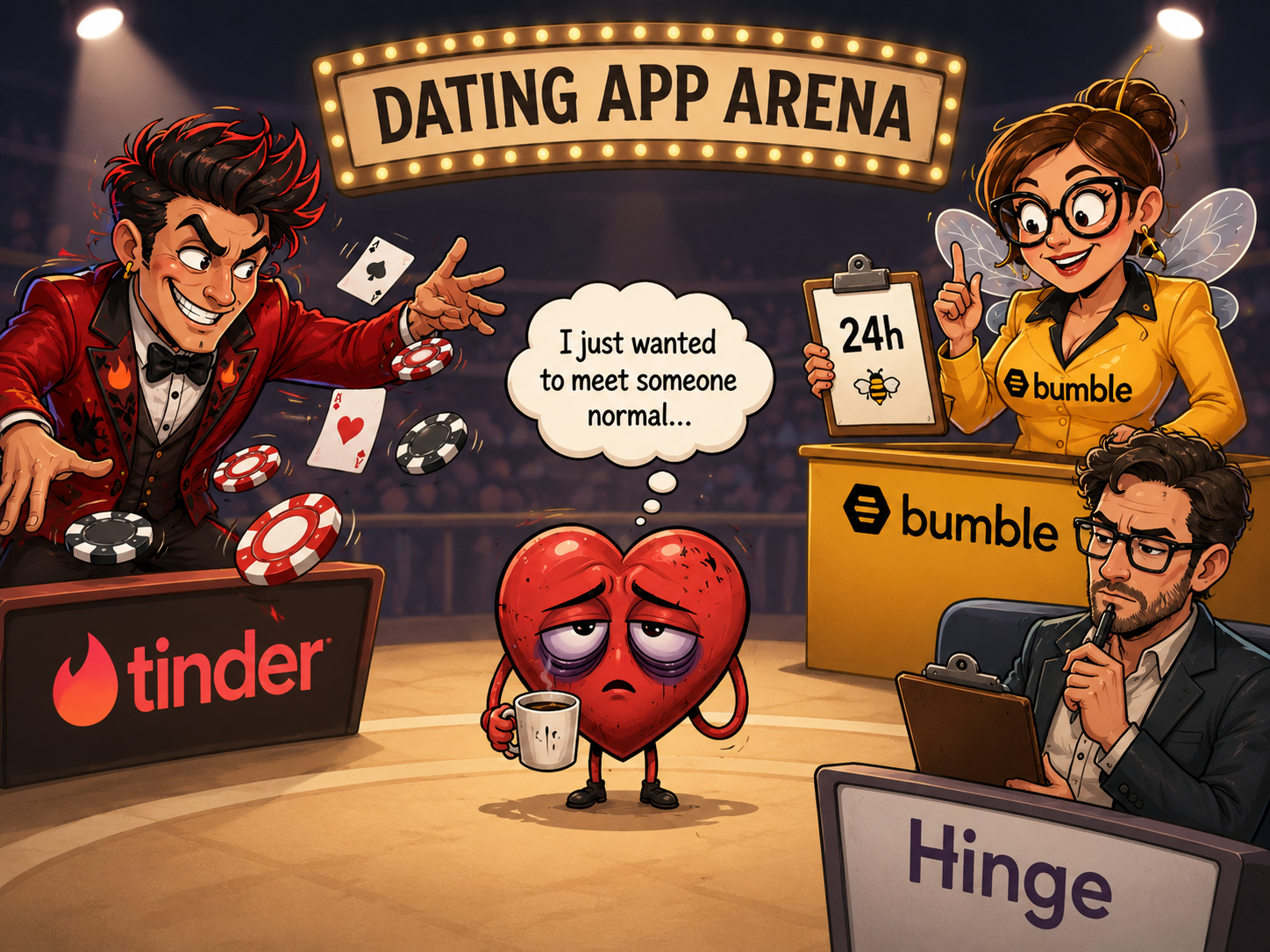
1. The Grabber: Welcome to Your Second Unpaid Job
Let's be brutally honest: dating apps in 2026 feel like a second job that you didn't apply for, definitely aren't getting paid to do, and where the HR department constantly ghosts you.
You know the drill. You download all three major apps—Tinder, Bumble, and Hinge. You upload the exact same five photos. You copy and paste the same bio because you’re too exhausted to write a new one. You swipe until your thumb literally goes numb, staring blankly at screen after screen of the same poses, the same dog photos, and the same group shots where you can't even tell which one she is.
And when you finally get a match? You send the exact same "Hey, how's your weekend going?" message.
You wait. A few hours go by. Maybe a day. You open the app. Read. No reply.
You think she didn't reply because she's busy with work. You think she didn't reply because she fell asleep. You rationalize it by saying, "Oh, she probably just deleted the app."
No. She is not busy.
She is currently lying in bed, staring at her phone, actively ignoring your message while responding to the guy who knew exactly how to break her pattern. The guy who didn't sound like a generic NPC (Non-Playable Character).
If you are Googling "Tinder vs. Bumble vs. Hinge", you are probably looking for a breakdown of technical features. You want to know who has the best filters, the cheapest premium subscription, or the most users. You are looking for a hardware solution to a software problem.
Stop. Comparing features is a trap.
To win in modern digital dating, you must stop comparing the UI and start comparing the psychology of the user base. Each app conditions women to behave in completely different ways. The interface dictates the behavior. If you understand the psychological architecture of the platform, you can hack the interaction. If you don't, you are just an unread notification collecting digital dust.
2. The New Ecosystem of 2026 (The Premises of Power-Saving Mode)
Before we dissect the apps individually, you need to accept the brutal reality of the dating ecosystem in 2026. If you do not internalize these three premises, no amount of swiping will save you.
Premise 1: The Paradox of Choice is Paralyzing
An average attractive woman on any of these apps has 99+ likes within an hour of creating an account. She does not have a scarcity problem; she has an abundance problem. When a human being is presented with infinite choices, the brain shuts down. This is called the Paradox of Choice. She is experiencing severe decision fatigue. Every message she opens is another micro-decision she has to make.
Premise 2: The "Power-Saving Mode"
Because her brain is overwhelmed by the sheer volume of male attention, she enters what behavioral psychologists call "Power-Saving Mode." She is swiping on autopilot to conserve emotional bandwidth. She is not reading your carefully crafted bio. She is looking for a reason to say "no" so she can reduce her queue. You are not being evaluated fairly; you are being processed by a stressed neurological system.
Premise 3: The "Insurance Broker" Phenomenon
Because she is in Power-Saving Mode, any message that requires logical thought feels like labor. If you speak like an insurance broker—asking logical, interview-style questions like "What do you do for work?" or "How long have you lived in the city?"—you will be treated like one. She will ignore you because answering you requires effort she isn't willing to spend.
The Conclusion: You are not competing against "better looking guys." You are competing against the algorithm, and you are competing against her overwhelming desire to just close the app and go watch Netflix. You need a jolt, not a greeting. And that jolt needs to be calibrated perfectly to the specific app you are using.
3. Tinder: The Casino of Dopamine (The Visual Volume Game)
Tinder is no longer a dating app. Let's get that straight. It is a highly gamified slot machine designed by behavioral engineers to spike dopamine through rapid visual processing.
The Myth of the Elo Score (And How the Algorithm Actually Works in 2026)
For years, dating coaches told men to "raise their Elo Score"—a system borrowed from chess rankings where you were assigned a desirability number. If you swiped right on everyone, your Elo dropped.
Here is the 2026 reality: The pure Elo Score is dead.
Tinder officially abandoned the static Elo system years ago. In 2026, the algorithm operates on a Dynamic Engagement Engine. It does not just rank you on how hot you are; it ranks you on how valuable you are to the platform's retention metrics.
The algorithm tracks:
- Swipe Velocity: Are you swiping like a bot? If you swipe right on 100 profiles in 60 seconds, the algorithm flags you as a desperate, low-value user and immediately shadowbans you (your profile becomes invisible to high-tier women).
- Message Initiation Rate: When you get a match, do you message her? If you just collect matches for an ego boost and never chat, your visibility tanks.
- Response Rate: Do women reply to you? If you send 50 "Hey" messages and get 0 replies, Tinder decides you are providing a bad user experience for their female demographic and buries your profile.
The Psychology: Fast Swipes and Frictionless Rejection
Tinder operates on speed. The UX is designed for split-second decisions. Because there are no mandatory prompts or detailed bios required, the entire platform relies heavily on visual micro-judgments.
When a woman is on Tinder, her brain is in a highly reactive, superficial state. She is not looking for a deep emotional connection in the first three messages; she is looking for a quick hit of entertainment or physical validation. She is holding her phone in one hand, probably watching a show on the couch, swiping while barely paying attention.
The Trap: Trying to Have a Deep Conversation in a Casino
The biggest mistake men make on Tinder is trying to have a slow, meaningful conversation. If you ask her what her major is, or how her Tuesday is going, you are creating massive cognitive friction. You are asking her to do emotional labor on an app she opened while waiting in line for coffee.
You are walking into a Las Vegas casino, sitting down at a loud slot machine, and trying to read a philosophical novel. You are in the wrong environment for that behavior.
The MatchGenius Verdict on Tinder
- Best For: High-volume hookups, casual dates, and men with top-tier, professional-level photography (top 10% visual value).
- The Flaw: Highest flake rate in the industry. Matches rarely translate to actual dates without aggressive escalation.
- How to Hack It: You must be polarizing and fast. Use High-Tension Openers immediately. Do not ask how her day was. Tell her she looks like trouble. Skip the small talk and aim for the number or the date within the first 10 messages.
4. Bumble: The Customer Service Internship (The Passive Trap)
Bumble’s entire marketing premise is built on female empowerment: "Women make the first move." It sounds like a utopia for men tired of sending the first message. In reality, this feature has created one of the most frustrating psychological traps in the history of modern dating.
The Illusion of Female Leadership
By forcing women to message first within 24 hours, Bumble attempts to remove the barrage of creepy opening lines. However, remember Premise 2? Women suffer from massive dating app fatigue.
So, what actually happens when she is forced to start the conversation? She takes the path of least resistance.
In 2026, 90% of the opening messages men receive on Bumble are:
- "Hey"
- "Hi"
- "Hey there"
- A waving hand emoji 👋
- A generic GIF of a dog waving
She is not taking the initiative. She is simply punching the clock. She is fulfilling the mandatory algorithmic requirement to open the door so the match doesn't expire.
The Trap: Becoming the Unpaid Customer Service Intern
Because she messaged first, the average guy assumes she is going to lead the conversation. He feels validated. He thinks, "Wow, she reached out to me, she must be interested!"
So, the guy replies with, "Hey! How are you? How's your week going?"
Congratulations. You just got hired as an unpaid customer service intern.
The moment you accept her lazy "Hey" and respond with a polite, logical question, the sexual tension dies instantly. Her brain, already in power-saving mode, files you into the same mental folder as the guy who calls offering to upgrade her cell phone data plan: predictable, boring, and easily ignorable.
She sent "hey" because the app forced her to. She still expects you to walk through the door and take charge of the interaction. When you reply with a boring greeting, you fall into the "Passive Trap." You prove you don't know how to lead.
The MatchGenius Verdict on Bumble
- Best For: Men who are excellent at conversational judo and have thick skin. It attracts women looking for slightly more serious connections than Tinder, but they still want to be chased.
- The Flaw: The 24-hour timer creates artificial pressure, and the "women message first" rule makes men lazy.
- How to Hack It: You must aggressively flip the script. When she sends her lazy "hey," you must immediately deploy a Cognitive Pattern Break. You have the right—and the duty—to playfully shame her for it.
- The MatchGenius Script: "Just 'hey'? And here I was thinking Bumble was the place where women would sweep me off my feet with brilliant pickup lines. I want a refund."
- Why it works: This is not a seduction technique; it is a pattern break. You force her out of autopilot. You playfully mock her lack of effort, forcing her to qualify herself to you and prove she is more interesting than a bot. You instantly take the dominant frame.
5. Hinge: The Conversational Engine (The 'Nice Guy' Graveyard)
Hinge brands itself as the app "designed to be deleted." It markets itself as the anti-Tinder. Out of the Big 3, it is objectively the most successful platform for converting matches into real-world, high-quality dates in 2026. But it is also a graveyard for "Nice Guys."
The Psychology: Forced Cognitive Processing
Hinge forces users to interact with specific prompts (e.g., "A shower thought I recently had...", "We'll get along if...", "My most controversial opinion is...").
This is a brilliant piece of UX design because it drastically slows down the swiping speed. Because a user has to actually read text and scroll vertically, her brain shifts out of the "Tinder Slot Machine" mode and into an evaluative, narrative-driven mode.
Furthermore, you can message someone before you match with them by commenting on their prompt. This is a massive advantage for men who know how to write.
The Trap: The Unpaid Interviewer
Because Hinge gives you so much information—her favorite food, her travel goals, her stance on pineapple on pizza—men fall into the devastating trap of becoming Unpaid Interviewers.
If her prompt says: "I love finding the best spicy margaritas in town," the average guy replies: "Oh cool, what's your favorite spot?"
If her prompt says: "I geek out on... true crime podcasts," the average guy replies: "Which one is your favorite?"
You are now the 400th guy asking her that exact same logical question. You are safe. You are polite. And you are completely, utterly forgettable. You are treating a flirting platform like a LinkedIn networking event.
The MatchGenius Verdict on Hinge
- Best For: High-quality dates, serious relationships, and men who know how to wield subtext, teasing, and copywriting.
- The Flaw: It requires significantly more mental effort per like. If your messaging game is weak, you will waste your limited daily likes very quickly.
- How to Hack It: Never answer or reply to a Hinge prompt logically. You must use playful antagonism, teasing, or what we call "Led Vulnerability".
- Instead of: "What's your favorite spot for margaritas?"
- Use the MatchGenius Script: "I know the absolute best spot for spicy margs in the city, but I only reveal my secrets to people who can handle the heat. Are you a tourist or a professional?"
- Why it works: You didn't ask her for a recommendation (which places her in the high-status position). You claimed you have the secret, and you challenged her ability to handle it. This triggers her competitive nature and establishes a playful, high-tension dynamic instantly.
6. The Ultimate Winner: Which App Should You Choose?
So, who wins the battle of Tinder vs. Bumble vs. Hinge in 2026? It depends entirely on your arsenal.
- If your photos are in the top 1% and you want sheer volume and casual encounters: Go with Tinder. Just remember you are playing a casino game.
- If you have thick skin, quick wit, and know how to flip a boring "hey" into a high-tension challenge: Go with Bumble.
- If you want the highest conversion rate from a digital match to an actual, high-quality real-world date: Go with Hinge. It rewards intelligence and conversational dominance more than any other platform.
The Ultimate Hack
But here is the ultimate secret that the algorithms don't want you to know: It does not matter which app you use if your texting strategy is broken.
If you text like a boring "nice guy," you will get ghosted on Tinder, you will get ghosted on Bumble, and you will be left on read on Hinge. The platform changes, the interface changes, but human evolutionary psychology remains exactly the same. Women are biologically wired to respond to confidence, playful tension, and emotional intelligence. They are wired to ignore the predictable.
If you are tired of being the polite guy who never makes it past the "how was your day" phase, perhaps it's time to stop fighting the algorithm manually.
At MatchGenius, we don't care which app you use. Our AI Subtext Translator integrates seamlessly with all of them. Whether you are trying to survive the Tinder casino, flip the script on a Bumble "hey," or craft the perfect teasing challenge for a Hinge prompt, our behavioral engine analyzes her specific psychological profile and feeds you the exact scripts needed to break her pattern and secure the date.
If you are tired of being the unpaid customer service intern, you might want to see how MatchGenius thinks for you.
Stop being the Unpaid Interviewer. Discover MatchGenius and command the conversation today.
7. Frequently Asked Questions
Which dating app is best for serious relationships in 2026?
Hinge is objectively the best dating app for serious relationships in 2026. Unlike Tinder's speed-swiping interface, Hinge utilizes mandatory text and voice prompts that force vertical scrolling, which slows down the user's cognitive processing. This forces users to evaluate personality compatibility and lifestyle markers rather than just physical appearance. Consequently, Hinge boasts the highest match-to-date conversion rate and a significantly lower flake rate for users seeking long-term, real-world connections.
Is Tinder dead in 2026?
Tinder is not dead, but its utility has fundamentally shifted from a dating platform to an entertainment and casual hookup engine. In 2026, Tinder functions almost exclusively as a high-volume, visually driven algorithm. Because it relies heavily on a Dynamic Engagement Engine (the modern evolution of the Elo Score), male users without top-tier, professional photography are heavily deprioritized. It remains effective for high-volume, superficial swiping, but it possesses the lowest intent-to-date metric among the major platforms.
Do women actually message first on Bumble?
Yes, Bumble’s core structural mechanic still requires women to send the first message within a 24-hour window before the match expires. However, due to severe dating app fatigue and the paradox of choice, the vast majority of first messages sent by women are low-effort greetings such as 'hey' or a simple emoji. Men who succeed on Bumble understand that they must still lead the interaction; they do not wait for the woman to drive the conversation. Instead, they immediately take control by playfully calling out the low-effort opener and establishing conversational tension.
How does the Tinder Algorithm work now if the Elo Score is dead?
Tinder abandoned the traditional "Elo Score" ranking system and replaced it with a Dynamic Engagement Engine. In 2026, the algorithm prioritizes users who provide a good experience for other users. It tracks "Swipe Velocity" (penalizing users who rapid-swipe right on everyone to prevent bot-like behavior), "Message Initiation" (rewarding users who actually chat with their matches), and "Response Rate" (promoting profiles that receive positive replies). Your visibility on Tinder is now directly tied to your active, high-quality engagement on the platform, not just a static attractiveness number.
Which dating app has the highest success rate for average guys?
For the average guy seeking dates rather than mere validation, Hinge provides the highest success rate. Because Hinge limits daily likes for free users and allows you to attach a message to your initial like, it levels the playing field for men who possess strong conversational and copywriting skills. Men who utilize "Cognitive Pattern Breaks" and playful teasing in their initial comments on Hinge can consistently bypass the visual algorithm and out-compete more conventionally attractive men who rely purely on their photos.